


- Qazi Hassam Mehmood
- 20 Apr 2026
- Market Trends and Analysis
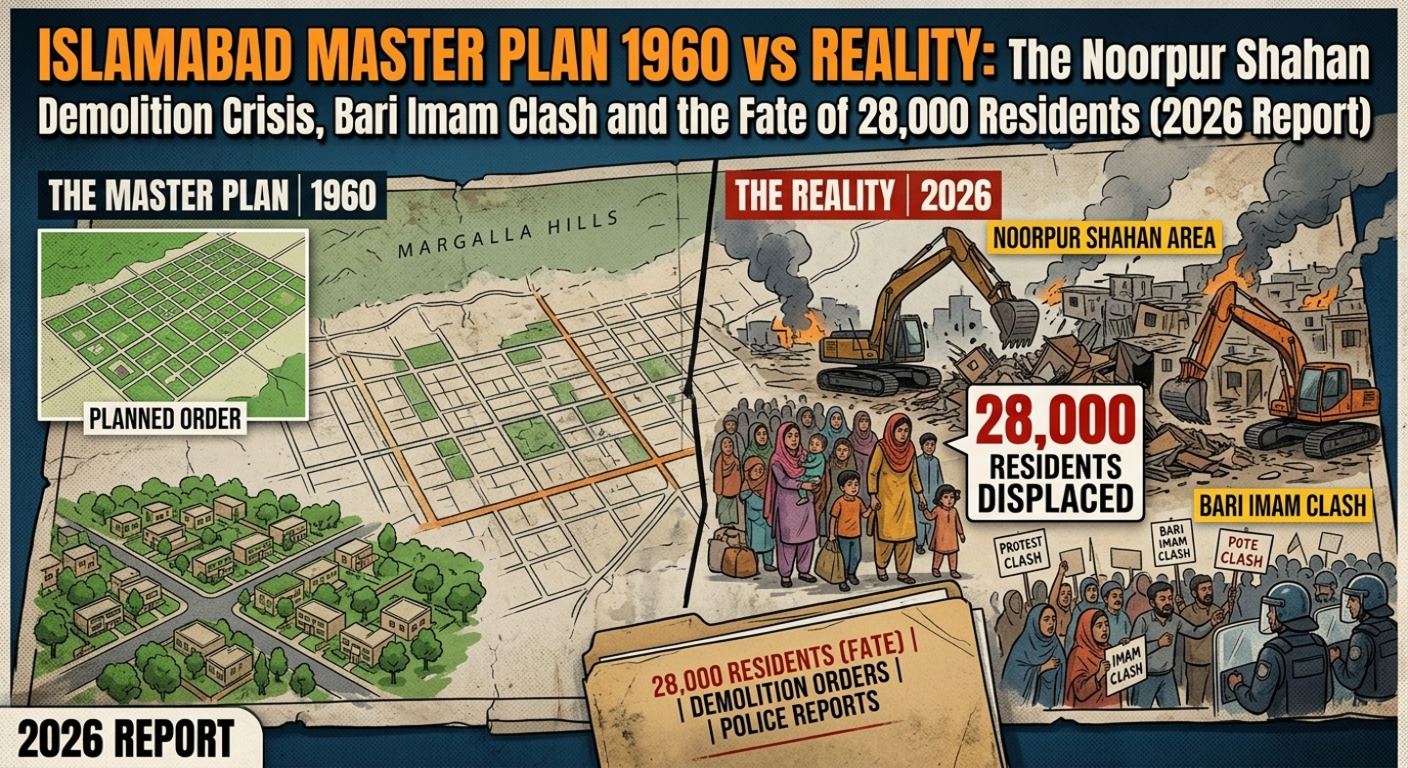
Islamabad Master Plan 1960 vs Reality: The Noorpur Shahan Demolition Crisis, Bari Imam Clash and the Fate of 28,000 Residents (2026 Report)
Islamabad was envisioned as a modern, green capital city when its Master Plan was designed in 1960 by the renowned Greek architect firm Doxiadis Associates. The plan emphasized clear zoning, residential sectors, commercial areas, and large green belts to maintain ecological balance.
Sixty-six years later, one of the most controversial chapters in Islamabad’s urban history is unfolding in Noorpur Shahan (Noori Bagh Mohallah), adjacent to the historic Bari Imam Shrine. In March 2026, the Capital Development Authority (CDA) launched a major anti-encroachment operation that led to violent clashes, injuries to over 50 civilians and several policemen, and the demolition of more than 200 houses in a single day.
This is not an isolated incident. According to CDA figures, over 13,000 structures have already been demolished in recent months across Islamabad, with another 15,000 structures currently targeted. The Noorpur Shahan case has become a flashpoint, raising serious questions about urban planning, legal rights, rehabilitation policies, and government accountability.
The 1960 Master Plan of Islamabad
The Doxiadis Master Plan divided Islamabad into distinct sectors with specific functions. Green areas and buffer zones were integral to the design to protect the city’s ecology and provide breathing space.
Noorpur Shahan’s Position in the Master Plan:
- Located near Bari Imam Shrine
- Falls under Sector F-4 in the original plan
- Designated as a green/protected zone rather than a residential village
- Between 1961 and 1967, CDA acquired approximately 17,000 kanals of land in the area under the Land Acquisition Act
The March 2026 Clash and Demolition Operation
Tuesday’s Violent Clash:
- CDA began anti-encroachment action in Noori Bagh Mohallah
- Residents strongly resisted the operation
- Police registered an FIR against 350 nominated and unidentified individuals under the Anti-Terrorism Act, attempted murder, rioting, dacoity, and use of deadly weapons
Wednesday’s Large-Scale Demolition:
- With heavy police protection, CDA deployed multiple excavators and demolished over 200 houses
- Residents allege that household belongings were thrown out before demolition
- The entire Noori Bagh Mohallah was razed in one day
Residents’ Perspective
Local residents present a completely different narrative:
- They claim the land belongs to their ancestors and they have been living there for generations
- The government has been providing electricity, gas, and water connections for the past 60 years, issuing official meters and bills
- In 1990, CDA’s Regional Planning Directorate had approved a proposal for seven model villages, including Noorpur Shahan
- The Supreme Court of Pakistan in 2015 ruled that residents of katchi abadis cannot be evicted without proper rehabilitation
CDA’s Official Position
CDA officials maintain:
- The land was acquired legally between 1961–1967 following all procedures
- Noorpur Shahan is not a recognized village but part of Sector F-4 in the Master Plan
- All court cases have been decided in CDA’s favor
Legal Framework and Constitutional Questions
Key Laws Involved:
- Land Acquisition Act 1984 – Requires notice and compensation for registered owners.
- Supreme Court Judgment 2015 – Clearly states that residents of katchi abadis cannot be removed without rehabilitation.
- Article 9 of the Constitution – Right to Life and personal liberty.
- Article 38 – State shall provide basic necessities of life, in which provide housing is inculded.
Human and Social Impact
- Over 13,000 structures already demolished in recent months
- Approximately 15,000 more structures still targeted
- Nearly 28,000 people directly affected
- Women, children, and elderly residents are the most vulnerable
Environmental Controversy: Rawal Lake Pollution
CDA has cited pollution of Rawal Lake as one reason for the operation. Residents counter this by saying the majority of pollution comes from industrial waste and construction debris from government projects.
For more details on Rawal Lake’s environmental status, refer to reports by the Pakistan Environmental Protection Agency.
Double Standards in Islamabad’s Urban Planning
While Noorpur Shahan faces full-scale demolition, multiple reports highlight illegal commercial activities and zoning violations in sectors like G-6 and G-7 that have largely gone unchecked.
Way Forward: What Needs to Be Done?
- Immediate transparent rehabilitation plan for affected families
- Independent judicial inquiry into Tuesday’s clash
- Strict implementation of the 2015 Supreme Court judgment
- Review and update of the 1960 Master Plan
In Short
The Noorpur Shahan crisis is much more than a simple anti-encroachment drive. It represents a fundamental conflict between a 1960s Master Plan, decades of government-provided utilities, constitutional rights, and the harsh realities of urban development in 2026.
28,000 people are now asking one basic question: After living here for generations and receiving government services for 60 years, where should they go?
The resolution of this issue will not only determine the future of these families but will also set a precedent for how Pakistan balances planned urban development with human rights and justice.
Disclaimer: This report is for informational and analytical purposes only. It does not constitute legal advice. All parties are advised to consult official sources and legal experts for accurate guidance.